Sandstone and travertine care in Sydney's Eastern Suburbs
The Eastern Suburbs are built on and from Hawkesbury sandstone, and the harbour and ocean load that stone with salt every day. We clean and seal it from our base in Double Bay, gently and with the run-off captured.
- 33 suburbs
- $20 million public liability
- Price on request
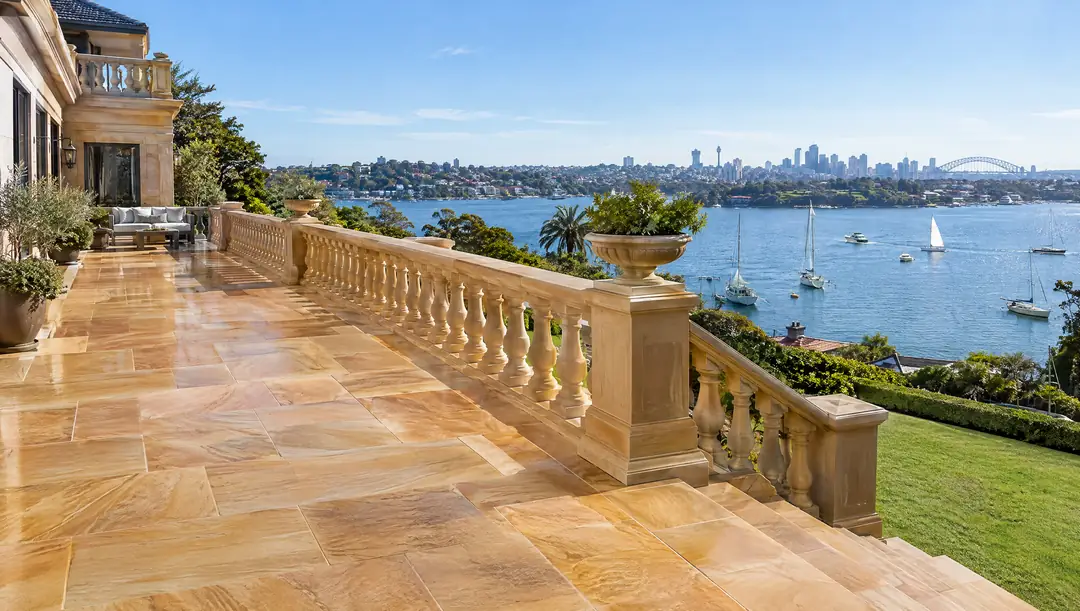
The Eastern Suburbs sit on Hawkesbury sandstone, a Middle Triassic rock laid down roughly 247 to 242 million years ago. It is made almost entirely of quartz grains held together by clay, and when it was quarried as 'yellowblock' it weathered to the warm yellow-brown that marks so much of Sydney's nineteenth-century building. The region shows it at every scale: the Vaucluse House estate, Victoria Barracks in Paddington, the 1850s to 1870s villas of Randwick and the sandstone semis of Bronte, cut from quarries near Waverley Cemetery. Most properties here carry some of it, whether a garden wall, a flight of front steps, a sea wall or a pool coping, and nearly all of it is softer than it looks.
Exposure splits the region in two. Along the harbour, from Darling Point and Double Bay out through Point Piper, Rose Bay and Vaucluse, stone faces calmer water but still takes splash on sea walls, strong reflected sun and a steady load of airborne salt. On the ocean side, Dover Heights, Bondi, Tamarama, Bronte, Clovelly and Coogee face the open sea, and onshore wind carries spray well back from the cliff line. Research from the University of Technology Sydney names salt as one of the main enemies of Sydney sandstone in coastal areas. Salty water soaks into the pores, the water evaporates, and the crystals left behind push the grains apart. That is the flaking and white bloom most owners notice first.
Three councils cover most of the region, and each takes heritage seriously. Woollahra Council looks after the harbour suburbs and has 15 heritage conservation areas, including Paddington, rezoned in 1968 as Australia's first conservation area, plus large areas in Woollahra and Watsons Bay with their own planning chapters. Waverley Council lists 17 conservation areas, among them Busby Parade in Bronte and the Bondi Beach area along Campbell Parade. Randwick Council has 21, including the St Judes precinct in Randwick and the Dudley Street and Edgecumbe Estate areas in Coogee. The part of Paddington south of Oxford Street falls under the City of Sydney. If your home is a listed item or sits inside one of these areas, check with the relevant council before significant stone work begins.
The same problems turn up in predictable places. Shaded, south-facing retaining walls on the ridges of Bellevue Hill and Darling Point grow black mould and lichen. Old sandstone footings and front steps in Paddington, Woollahra and Randwick draw up ground moisture and bloom with salt. Pool coping on harbourfront and clifftop properties pits and turns sugary at the waterline. Travertine terraces get etched by acidic pool-shop cleaners, and sandstone gets scarred by pressure washers held too close. Our technicians answer each of these the same careful way: a test patch first, low pressure on sandstone, no acid on travertine, and breathable penetrating sealers. Wash water is captured on site rather than sent down the stormwater drain, which is meant for rainwater only.
Services in the Eastern Suburbs
Suburbs we cover
- Bellevue HillBellevue Hill is a ridge-top suburb of large gardens and interwar houses. Its stone problems…
- BondiBondi, the suburb behind the beach, is mainly apartments and shop terraces along Bondi Road.…
- Bondi BeachAlmost every home in Bondi Beach is an apartment, so most of the stone here is common property…
- Bondi JunctionBondi Junction is towers and transport in the centre and Victorian terraces on its edges. We…
- BronteBronte has some of the Eastern Suburbs' best local sandstone houses, many built of stone…
- Centennial ParkThe houses of Centennial Park line the western edge of the parklands on large, leafy blocks.…
- ChifleyChifley is a low to medium-density family suburb off Anzac Parade, where older homes are being…
- ClovellyClovelly is a compact, closely built suburb around a narrow ocean bay. Its stone is mostly…
- CoogeeCoogee packs apartment blocks of every era, a few grand old houses and a cliff-lined coast…
- Darling PointDarling Point runs along a narrow harbour headland lined with Victorian mansions and apartment…
- Double BayDouble Bay is our home suburb. Most of the stone we look after here belongs to apartment…
- Dover HeightsDover Heights sits on the ocean cliffs, and its contemporary homes take wind-driven salt spray…
- EdgecliffEdgecliff mixes Victorian sandstone villas with a dense run of apartment blocks around its…
- KensingtonKensington is mostly apartments, shaped by the university and the racecourse, with a heritage…
- KingsfordKingsford is half apartments and half houses, centred on the Anzac Parade strip at Nine Ways.…
- La PerouseLa Perouse is a small residential pocket on the headland at the mouth of Botany Bay,…
- Little BayLittle Bay grew from the old Coast and Prince Henry hospital site into a coastal precinct of…
- MalabarMalabar wraps around Long Bay, with the Malabar Headland to the north. Most homes are houses,…
- MaroubraMaroubra runs from the Junction shops down to a kilometre of surf beach. Its stone ranges from…
- MatravilleMatraville is a family suburb of houses and townhouses between Heffron Park and Botany…
- North BondiNorth Bondi runs from the Art Deco flats above the beach out to the cliffs at Ben Buckler. Its…
- PaddingtonPaddington's terraces sit on a high sandstone ridge, and most of them have sandstone at their…
- Phillip BayPhillip Bay is a small, mostly low-density suburb on Botany Bay, centred on Yarra Bay. Its…
- Point PiperPoint Piper is a small harbour peninsula of waterfront estates, and its stone works hard: sea…
- Queens ParkQueens Park holds some of the oldest worker cottages in the Eastern Suburbs, built from…
- RandwickRandwick has one of the richest collections of nineteenth-century sandstone in the Eastern…
- Rose BayMost Rose Bay residents live in apartments, so much of the stone here is common property:…
- South CoogeeSouth Coogee runs from Malabar Road down to the rocky shore at Lurline Bay. Its stone ranges…
- TamaramaTamarama is a small valley suburb between two headlands, open to the ocean. Whatever stone a…
- VaucluseVaucluse spans the South Head peninsula, with harbour beaches on one side and ocean cliffs on…
- Watsons BayWatsons Bay is a historic harbour village with ocean cliffs a short walk away. Its old…
- WaverleyThe suburb of Waverley grew around Charing Cross and runs out to the cemetery on the cliffs.…
- WoollahraWoollahra's streets are full of Victorian houses and small unit blocks, many inside one of the…
Frequently asked questions
Straight answers from our stone-care technicians.
Which Eastern Suburbs do you cover?
We work across the Woollahra, Waverley and Randwick council areas, including Vaucluse, Point Piper, Bellevue Hill, Rose Bay, Double Bay, Darling Point, Woollahra, Paddington, Dover Heights, Watsons Bay, Bondi, Bronte, Tamarama, Clovelly, Coogee and Randwick. If your street sits just outside that list, ask us. Our base is in Double Bay, so most of the region is a short drive away.
Is harbour-facing stone treated differently from ocean-facing stone?
The cleaning method is the same, but the maintenance plan is not. Ocean-facing walls and terraces on the clifftops take heavier, wind-driven spray and usually need sealer checks more often. Harbourfront stone often has more shade, more organic growth and pools close by. We set intervals after seeing the property.
Do I need council approval to clean sandstone in a heritage conservation area?
It depends on the property and the work. Routine, gentle maintenance is often treated differently from restoration or alteration, but the council decides. Check with Woollahra, Waverley, Randwick or the City of Sydney, whichever covers your address, before restoration work. We flag anything that may need approval when we quote.
Why won't you pressure wash our sandstone?
Because Hawkesbury sandstone is mostly quartz held together by soft clay. A high-pressure tip cuts into that binder and strips the weathered skin that protects the stone. We rely on biocides, patient dwell times and a gentle rinse, which removes the growth without removing the stone.
How do you price work in the Eastern Suburbs?
Every job is quoted individually after photos or a site visit. The main factors are the area, the condition of the stone, access (steep blocks and terraces without side lanes take longer), whether sealing is included and which sealer suits the exposure. We don't publish set prices because two similar-looking jobs can differ a lot.
Do you work for strata buildings and building managers?
Yes. Many Eastern Suburbs homes are apartments, and entry paths, front walls, steps and pool areas are usually common property. We agree access times with the strata or building manager, keep a safe route open for residents and can supply our public liability insurance details, which is $20 million through The Prestige Standard.