Sandstone and travertine care on the Northern Beaches
From the harbour side of Manly to the rocks of Little Head at Palm Beach, stone on the Northern Beaches lives with salt on two fronts. Our technicians clean it gently and seal it so it can still breathe.
- 44 suburbs
- $20 million public liability
- Price on request
The Northern Beaches sit on Hawkesbury sandstone, the porous Triassic quartz sandstone that forms Sydney's coastal cliffs and headlands. You can read it in the landscape: the hills that wrap around the southern side of Curl Curl, the sandstone heath of Stony Range in Dee Why, which grows on a former quarry site, and the rocks of Little Head at the far end of Palm Beach. Builders used what was underfoot. Most of Most of Palm Beach's early houses used local sandstone, Careel House at Whale Beach was built in 1931 from blocks quarried on its own site, and St Patrick's Seminary in Manly remains the region's best-known sandstone landmark.
Few parts of Sydney put stone under as much salt. The peninsula runs between the Pacific and, depending on where you are, Middle Harbour, North Harbour or Pittwater, so many homes catch spray from one side and humid estuary air from the other. UTS research on Sydney sandstone names salt as one of its main enemies in coastal areas: salty moisture enters the pores, dries out, and leaves crystals that grow and prise the grains apart. The result is flaking faces, powdery white bloom and pool coping that turns sugary at the edge. Storms add to it. Beachfront houses at Collaroy lost backyards in the June 2016 storms.
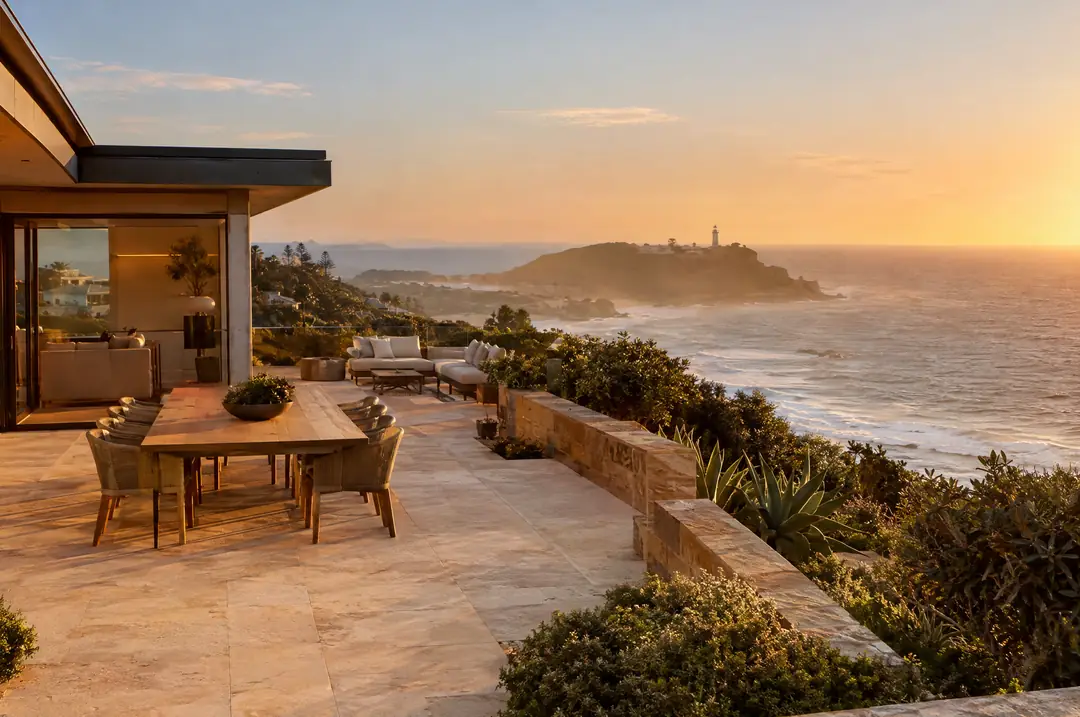
Beyond salt, the problems follow the landscape. Bushland lots near Garigal National Park, Dobroyd Head and Ku-ring-gai Chase drop leaves that leave tannin stains and keep walls shaded and damp, which suits black mould and lichen. Steep blocks mean long runs of sandstone stairs and retaining walls that rarely see full sun. Newer homes near the beaches often pair sandstone walls with travertine pool surrounds and terraces, and travertine has a weakness of its own: it is a limestone, so the acid cleaners many people reach for etch it. We plan every job around which stone is present and what is actually attacking it.
The whole region falls within Northern Beaches Council, whose administrative centre is in Dee Why. Heritage controls vary from street to street. Manly has mapped heritage conservation areas, including the Town Centre around The Corso and a Pittwater Road area, while elsewhere individual houses, gardens and structures can be listed as heritage items in their own right. If your property is listed, check with council before restoration work. Our technicians travel from Double Bay: Manly is roughly half an hour away off-peak and Palm Beach over an hour, both estimates. Every job starts with a test patch, uses low pressure and recovers wash water rather than letting it reach the street.
Services in the Northern Beaches
Suburbs we cover
- Allambie HeightsAllambie Heights is a post-war suburb of houses with bush on three sides. Its stone deals with…
- Avalon BeachAvalon Beach mixes bush, beach and a strong architectural history. Its stone deals with leaves…
- BalgowlahBalgowlah mixes older houses, semis and newer apartments around a busy shopping strip, all…
- Balgowlah HeightsOn a ridge above two harbours and beside national park bushland, stone in Balgowlah Heights…
- BayviewBayview climbs steeply from the southern shore of Pittwater, so a single property can run from…
- Beacon HillBeacon Hill rises to one of the highest lookouts on the Northern Beaches, with bush on its…
- BelroseBelrose is a family suburb on the plateau north of Frenchs Forest, bordered by two national…
- Bilgola BeachBilgola Beach is a small, steep valley opening onto the ocean, thick with cabbage tree palms.…
- Bilgola PlateauBilgola Plateau is a residential ridge high above Bilgola Beach, with views toward the ocean…
- BrookvaleBrookvale is mainly an industrial and commercial suburb, but most people who live there are in…
- Church PointChurch Point is where Pittwater Road ends and the ferries to Scotland Island and the western…
- ClarevilleClareville looks west over the sheltered waters of Pittwater from the Barrenjoey Peninsula.…
- ClontarfClontarf is a small waterfront suburb on Middle Harbour, between Sandy Bay and Castle Rock.…
- CollaroyCollaroy faces one of the most exposed stretches of coast in Sydney. Beachfront stone here…
- Collaroy PlateauCollaroy Plateau sits on the heights above Collaroy and Narrabeen, with bush and wildflower…
- CromerCromer runs from the high ground of Cromer Heights down to the edge of Narrabeen Lagoon. Its…
- Curl CurlCurl Curl is ringed by sandstone hills, ocean and lagoon. Its stone gets sea salt from one…
- DavidsonDavidson is a quiet suburb of houses built from the late 1970s on uneven ground beside Garigal…
- Dee WhyDee Why is mostly apartments, from 1960s shop-top buildings to newer mid-rise blocks near the…
- Duffys ForestDuffys Forest is a small acreage community on the ridge above Cowan Creek, bordered by…
- Elanora HeightsElanora Heights sits on the high ground above Narrabeen Lagoon with national park bush on two…
- FairlightFairlight falls steeply from Sydney Road to North Harbour, so most of its stone is stairs,…
- ForestvilleForestville is a suburb of family homes and townhouse villas framed by Garigal National Park…
- Frenchs ForestFrenchs Forest is a suburb of family homes on the plateau, bordered by Garigal National Park…
- FreshwaterFreshwater packs houses and apartments around a small surf beach between two headlands. Almost…
- InglesideIngleside is semi-rural country on the plateau behind Mona Vale, with acreage, nurseries and…
- Killarney HeightsKillarney Heights occupies a sandstone ridge between Middle Harbour and Bantry Bay, ringed by…
- ManlyManly has harbour on one side, ocean on the other and a long history of building in sandstone.…
- Manly ValeManly Vale runs from Condamine Street up to the edge of Manly Dam, with creeks and playing…
- Mona ValeMona Vale combines a busy town centre with beachfront and Pittwater-side homes. Salt from the…
- NarrabeenNarrabeen sits between the surf and a large coastal lagoon, and much of its stone belongs to…
- NarraweenaNarraweena is a quiet, hilly suburb of post-war homes in the hills behind Dee Why. Its stone…
- NewportNewport runs from the ocean to Pittwater, so its stone ranges from salt-blasted clifftop…
- North BalgowlahNorth Balgowlah is a suburb of houses on the edge of Manly Dam's bushland. Its stone problems…
- North Curl CurlNorth Curl Curl climbs the southern slopes of Wingala Hill above its beach and lagoon. Its…
- North ManlyNorth Manly sits on low ground around the upper reaches of Manly Lagoon, with parkland and a…
- North NarrabeenNorth Narrabeen runs from a well-known surf break to the north shore of Narrabeen Lagoon. Its…
- Palm BeachMost of Palm Beach's early houses were built from local sandstone. A century of salt from the…
- QueenscliffQueenscliff is mostly apartments, packed between the northern end of Manly Beach and the…
- SeaforthSeaforth looks over Middle Harbour and Sugarloaf Bay, with Garigal National Park on its…
- Terrey HillsTerrey Hills is leafy, partly semi-rural and known for its laterite, the red, iron-rich ground…
- WarriewoodWarriewood combines a beach, protected wetlands and a valley of newer homes. We look after its…
- Whale BeachWhale Beach homes climb steep slopes straight above the Pacific. Few places in Sydney put…
- Wheeler HeightsWheeler Heights is a small residential suburb on the high ground between Cromer and Collaroy…
Frequently asked questions
Straight answers from our stone-care technicians.
Which Northern Beaches suburbs do you cover?
The whole council area, from Manly, Fairlight, Balgowlah Heights, Clontarf and Seaforth in the south, through Freshwater, Curl Curl, Dee Why and Collaroy, up to Mona Vale, Newport, Avalon Beach, Whale Beach and Palm Beach. The upper peninsula takes longer to reach from Double Bay, so we confirm timing when we quote.
Why does sandstone near the beach deteriorate faster?
Salt. Spray and sea air deposit salt on the stone, rain and dew carry it into the pores, and as the moisture dries the salt crystallises and pushes the sand grains apart. Over many cycles that shows up as flaking, powdering and white bloom, usually worst on the side facing the water.
Can salt damage on sandstone be stopped?
It can be slowed a great deal, not reversed. Regular freshwater rinsing, a breathable penetrating sealer on paving and coping, and fixing anything that keeps the stone wet all reduce how much salt gets in. Stone that has already eroded will not grow back, though restoration can stabilise it and improve its appearance.
Do I need council approval to clean or seal sandstone on the Northern Beaches?
For most homes, routine cleaning is maintenance. If your property is a listed heritage item or sits in one of Manly's heritage conservation areas, some works may need approval, so check with Northern Beaches Council before restoration, repointing or anything that changes the stone. We are happy to describe our method in writing for that conversation.
Is travertine a good choice around a Northern Beaches pool?
Yes, provided it is sealed and looked after. Travertine is denser than sandstone and stays comfortable underfoot, but it is acid-sensitive and will absorb salt water if left unsealed. A salt-resistant penetrating sealer, acid-free cleaning and a regular freshwater rinse keep it in good condition.
How do you stop wash water reaching the beach or the lagoons?
We bund the work area, vacuum-recover the run-off as we go and take it away for proper disposal. Around Dee Why Lagoon, Curl Curl Lagoon, Pittwater and the ocean beaches, nothing from our cleaning is meant to reach a street drain.