Sandstone restoration
Restoration goes past cleaning. It deals with what has gone wrong inside the stone: deep rust and salt staining, failed coatings, crumbling joints and surfaces worn soft by weather or bad cleaning.
- $20 million public liability
- Eastern Suburbs & Northern Beaches
- Price on request
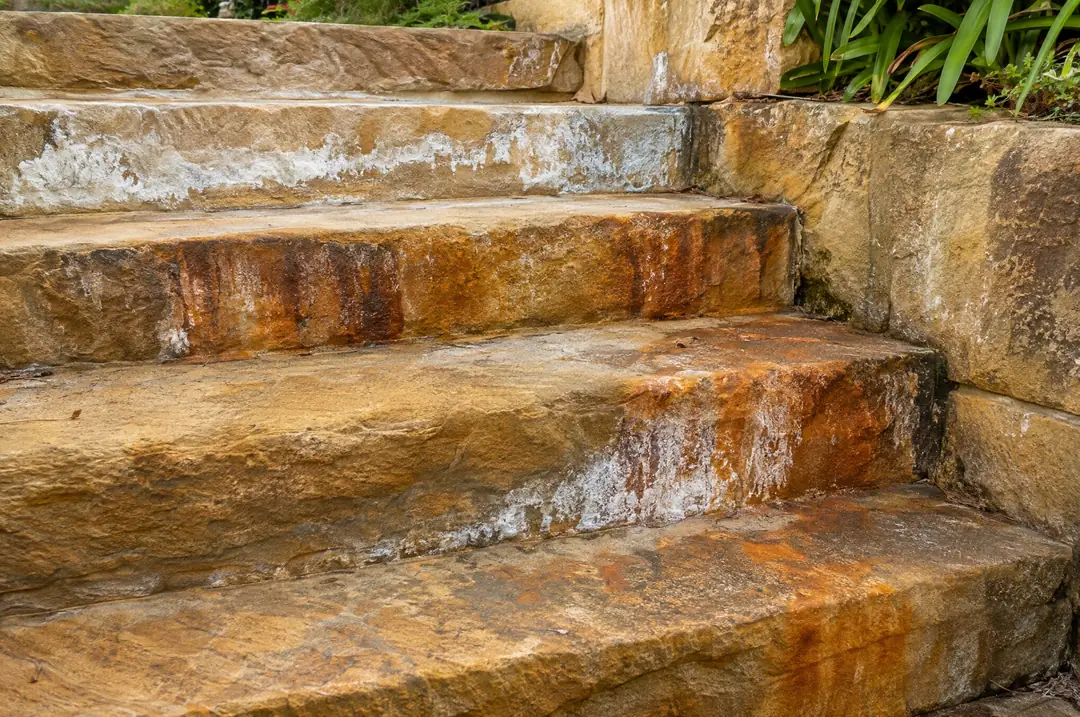
Sandstone steps, retaining walls, gate piers and facades define many Eastern Suburbs and Northern Beaches homes. Over decades they gather iron staining from fixings and the stone's own minerals, salt crystallising inside the pores, cement-based repairs that are harder than the stone around them, and coatings that have gone yellow and started peeling.
We assess each problem separately and use the least invasive fix that works: poultices to draw out deep stains, strippers to remove failed coatings, and careful raking and repointing with a mortar softer than the stone. Where stone is badly eroded or delaminating, we tell you plainly when replacement or patch repair by a stonemason is the better call, and work alongside one if you need it.
If your home is heritage-listed or in a heritage conservation area, some restoration works need council approval. We'll flag this before quoting so there are no surprises.
Signs you need sandstone restoration
- Orange-brown rust bleeding from bolts, rails or the stone's own iron
- White, powdery salt bloom that keeps coming back
- Sandy, crumbling faces or spalling at the base of walls
- Hard grey cement pointing with the stone eroding around it
- A yellowed, peeling or patchy old sealer
- Graffiti or paint on porous stone
How we do it
- Condition surveyWe photograph and map the issues (stains, salts, coatings, joints and erosion) and explain what each one needs.
- Remove what doesn't belongFailed coatings are stripped, paint and graffiti removed, and inappropriate cement repairs noted for correction.
- Draw out stains and saltsPoultices are applied and left to dry, pulling rust, oil and salts out of the pores rather than bleaching the surface.
- Repair jointsDefective joints are raked out and repointed with a lime-based mortar matched to the stone, so the joint gives before the stone does.
- Clean, protect and recordA final clean, an optional breathable sealer once the stone is dry, and a photo record of the work for your files.
Softer than the stone, always
The most common long-term damage we see comes from repairs that were too strong. Cement mortar and hard patching compounds don't move or breathe like sandstone, so moisture and salts get forced through the stone instead, and the stone erodes around the joint. Conservation practice keeps repairs sacrificial and breathable, and so do we.
Restoration is quoted after an on-site inspection, because two walls that look alike can need very different treatment.
Aftercare
- Fix the moisture source (leaking downpipes, garden beds against walls, blocked weep holes) or the salts will return.
- Avoid fixing new metal straight into sandstone. Use stainless or isolated fixings.
- Have the work inspected every few years, especially on coastal sites.
Frequently asked questions
Straight answers from our stone-care technicians.
Can rust stains be removed from sandstone?
Usually a great deal can be removed with a poultice that draws the iron out, though deep staining may lighten rather than vanish completely. We test first and give you an honest expectation.
Why does white powder keep coming back on my sandstone?
That's efflorescence: salts carried by moisture moving through the stone. It returns until the moisture source is reduced. We treat the salts and help you find the cause.
Can you match old sandstone?
We repair joints and surfaces to blend with the existing stone. Where whole stones need replacing, a stonemason sources matching stone, and we can coordinate that.
Do I need council approval for sandstone restoration?
For heritage-listed properties and some heritage conservation areas, certain works may need approval. Routine maintenance is often treated differently from alteration. Check with your council first. Our regulations page explains the basics.
How long does restoration take?
A set of front steps may take a day or two, including poultice drying time. A long retaining wall or facade can take a week or more. We give you a timeline with the quote.
Do you do structural repairs?
No. Structural problems like leaning walls or cracked lintels need a structural engineer and a licensed builder or stonemason. We'll tell you if we see signs of them.
Related services
- Sandstone cleaningSandstone is soft. Blast it with a high-pressure tip and you remove the stone itself, not just the…
- Stone stain removalEvery stain has a chemistry, and so does every stone. Bleaching or acid-washing a stain usually…
- Sandstone sealingA good sandstone sealer is invisible. It sits inside the pores, not on top, so water beads off and…