Sandstone cleaning and sealing in Whale Beach
Whale Beach sandstone often faces the ocean head-on. Removing salt gently and sealing with a breathable product is the best way to slow its weathering.
- Whale Beach 2107
- $20 million public liability
- Price on request
In Whale Beach, sandstone is usually part of how the house meets the hill. Retaining walls hold each terrace level, long flights of stairs connect the street, the house and the path toward the beach, and paving runs out to the edge of the view. A few older homes use local stone in their walls, in the tradition of Careel House. The ocean-facing surfaces show salt first: a sandpapery feel underfoot, grey grime, and in places flaking or a white crust. Lower flights and terraces that sit in the shadow of the house turn green and slippery, and bare sandstone on the slope picks up grey lichen.
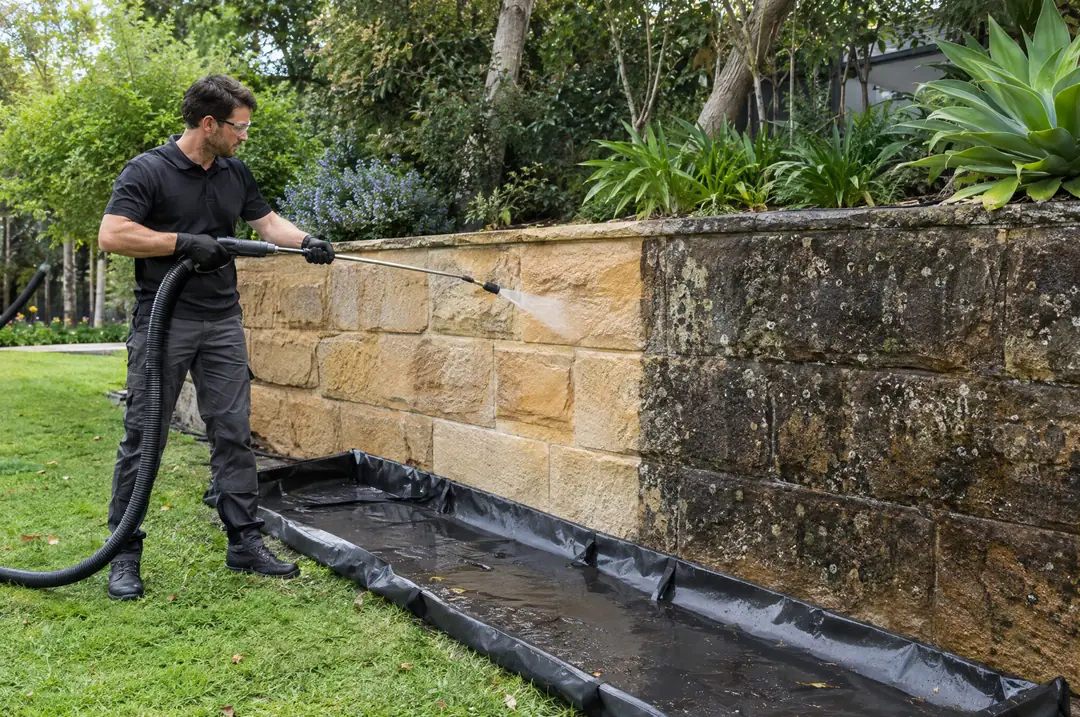
Every Whale Beach clean begins with a test patch, because the right pressure on a sheltered wall can be too much on a salt-softened step. Our technicians rinse surface salt away with fresh water first, then apply a biocide to the algae, mould and lichen and give it time to work before brushing. Where the stone already sheds grains, it is cleaned by hand or with barely more than a garden-hose flow. Acid stays off the site entirely, since it releases iron in Hawkesbury sandstone and leaves orange marks. Run-off is caught at each landing and carried out, not left to run downhill toward the sand.
On these sites, sealing pays off most on the surfaces that face the ocean and carry feet: decks, stair treads and pool coping. A breathable impregnator cuts down how much salty water those surfaces absorb, yet still lets them dry, and it leaves no gloss or slippery film. Retaining walls and old walls of local stone are a different case and are normally left unsealed, because they need to breathe moisture out through the face. We rinse salt off and wait for the stone to dry fully before sealing, and only on a still day. Test the most exposed paving with water drops every year.
Frequently asked questions
Sandstone questions we hear in Whale Beach.
Our sandstone stairs are flaking. Can they be cleaned safely?
Yes, gently. We clean by hand or with minimal pressure and can assess restoration options. Badly eroded treads may need a stonemason.
Should we seal old walls built from local sandstone?
Usually not. Older walls need to release moisture through their faces, and sealing can trap salt. We generally recommend gentle cleaning and leaving them to breathe.
How often should ocean-facing sandstone be cleaned?
Usually every year or two. Hosing salt off with fresh water between visits makes a real difference.
Can you match an enhancing sealer to weathered stone?
We test natural and enhancing sealers on your stone so you can compare. Enhancers deepen colour but also highlight variation in weathered stone.