Sandstone cleaning and sealing in Palm Beach
Palm Beach's early homes were built of local sandstone, and much of it is still in place. It responds best to the gentlest cleaning that works and selective sealing.
- Palm Beach 2108
- $20 million public liability
- Price on request
Palm Beach sandstone spans a century. At one end are the walls of the early cottages and bungalows, built from local stone around the time of the First World War; at the other are the retaining walls, stairs and terraces of larger, more recent estates. The older stone has spent its whole life in salt air, so the exposed faces are often soft, flaking or powdery, with a white bloom after dry spells. Many old walls also carry hard cement repairs, which push moisture and salt into the stone beside them. Estates on the bush fringe add lichen and leaf stains, while newer paving is denser but still drinks up salt if left unsealed.
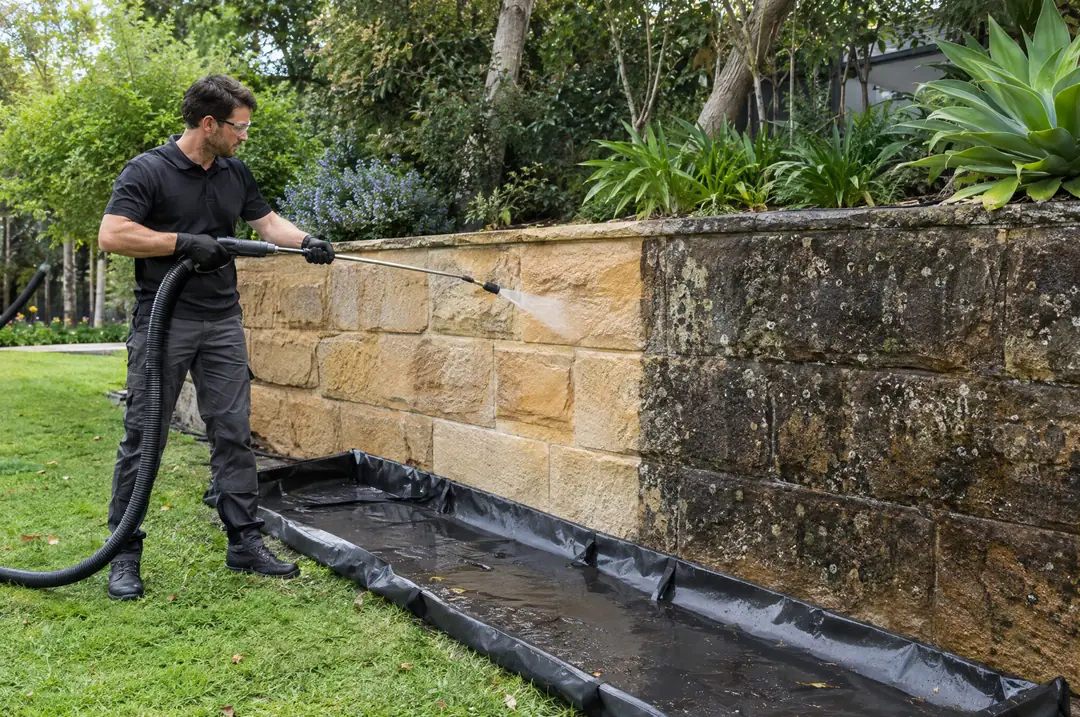
With old stone, the assessment matters as much as the clean. Our technicians check for earlier coatings, cement patches and areas that are already fragile before deciding how to proceed. Work begins with fresh water and soft bristles, and growth is treated with a biocide that is given time to dwell. Pressure stays at the low end, and the weakest areas are done by hand. Acids are never used, because they draw iron out of Hawkesbury sandstone and leave orange stains. Persistent salt bloom may need a poultice. Wash water is captured rather than sent toward Pittwater or the ocean, and if a stonemason is needed, we will say so.
For the early sandstone houses, our usual advice is not to seal the walls. Old masonry needs to let moisture out through its face, and a sealer can hold salt inside where it does the most harm. Horizontal surfaces are another matter: paving, steps, terraces and pool coping all benefit from a breathable impregnator that slows salt and staining while keeping a matte, natural finish. We wash off surface salt, let the stone dry completely and pick a still day. Where a home is heritage-listed, we discuss it with you before sealing anything. Ocean-side paving should be water-drop tested yearly; the Pittwater side usually lasts longer.
Frequently asked questions
Sandstone questions we hear in Palm Beach.
Should we seal the walls of our old sandstone cottage?
Usually not. Older walls need to breathe. Sealing can trap moisture and salt, leading to faster decay. Cleaning gently and fixing moisture sources is the better approach.
Our sandstone has a white powder that keeps coming back. What is it?
It is efflorescence, salts brought to the surface as moisture evaporates. Treatment removes it for now, but it keeps reappearing while damp is still moving through the wall.
Can you clean sandstone without changing its weathered look?
Yes. Our aim is to remove dirt and growth while keeping the stone's character. Nothing is ground back or blasted.
Do you work with stonemasons on restoration?
Yes. Where stones need replacing or structural repair, a stonemason is needed, and we can coordinate cleaning and sealing around their work.