Sandstone cleaning and sealing in Avalon Beach
Avalon sandstone spends much of its life under trees. Leaf stains, lichen and mould are the usual problems, with salt added near the beach and headlands.
- Avalon Beach 2107
- $20 million public liability
- Price on request
On Avalon's sloping bushland lots, sandstone is used for garden walls, retaining walls, steps and paths, often surrounded by trees. Under the canopy these surfaces rarely dry out, so black mould and green algae thrive, and lichen spreads across the tops of walls. Leaves falling onto paving and steps leave brown tannin stains, especially where they sit wet after rain. Closer to the beach and the headlands, the problem shifts toward salt: grey grime, white bloom and gritty surfaces. Older architect-designed homes may also have stone with previous coatings that have aged and discoloured.
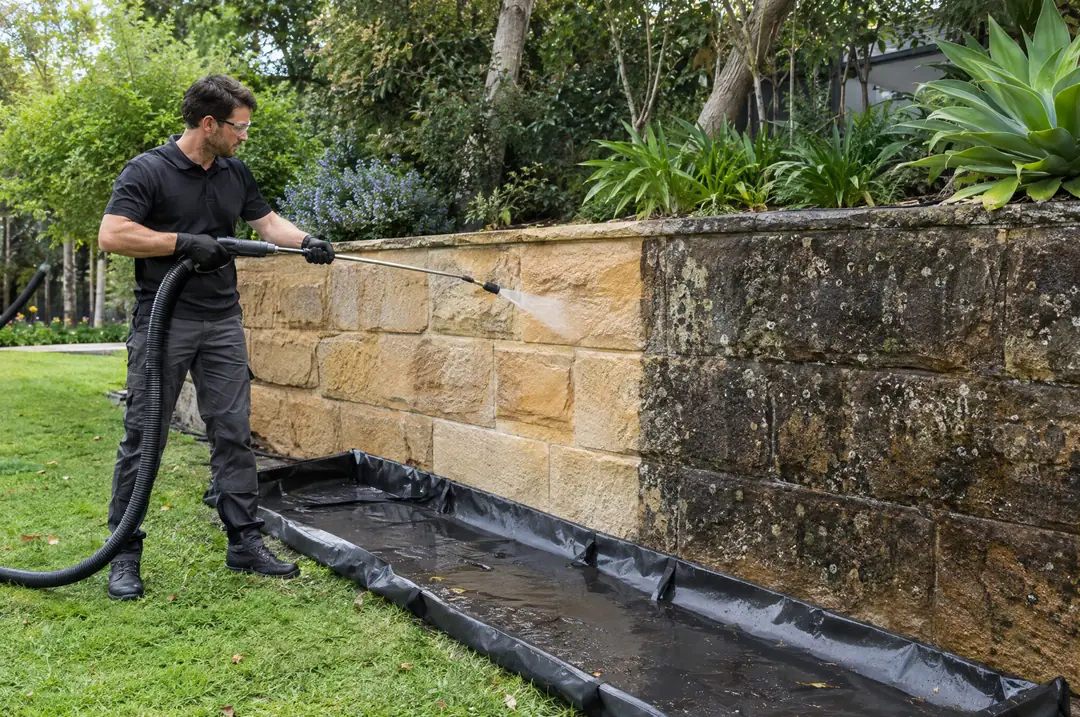
Avalon sandstone is cleaned after a trial on a hidden patch, using a biocide to kill mould, algae and lichen at the root, after which the stone is brushed by hand and rinsed at no more pressure than it needs. Tannin stains are lifted with a specific cleaner or, if deep, a poultice. On older stone, we check for previous coatings before choosing a method, because some need stripping before the stone can be properly cleaned or sealed. No acid, which leaves orange staining in Hawkesbury sandstone, and no narrow high-pressure jets. Run-off is captured rather than left to soak into the bush.
Sealing is worthwhile on paving, steps and pool coping, especially where leaves fall regularly. A breathable penetrating sealer slows tannin uptake so leaves can be swept away before they stain, and near the beach it reduces salt absorption. Retaining walls and freestanding garden walls usually stay unsealed so they can breathe. Shaded Avalon stone takes time to dry, so sealing is a separate visit after a dry spell, with moisture checked first. On heritage-listed or older architect-designed homes, we discuss sealing with you before proceeding, as some stonework is best left unsealed.
Frequently asked questions
Sandstone questions we hear in Avalon Beach.
Our sandstone paths are covered in lichen. Will it come back?
Lichen regrows slowly on shaded stone. A biocide treatment kills it at the root, and a maintenance clean every year or two keeps it in check.
Our older stone has a yellowed coating. Can you remove it?
Usually. Failed coatings are tested and stripped with suitable products before the stone is cleaned. Stripping is quoted separately, as it depends on the coating.
Should we seal the sandstone near our pool?
Generally yes. Coping and paving near a pool take water, salt and leaves. A breathable penetrating sealer helps, and we test the finish for grip first.
Can you treat stone on a heritage-listed home?
Yes, with the gentlest method that works. If the home is listed, ask council whether restoration needs approval first.